Singing Along

If Disney is a religion, singing is one of its core rituals.
Last week, Walt Disney World’s Carousel of Progress shut down for a long refurb. Lines were long for one “final” ride of the current version, a cult favorite among fans who love classic attractions. Then the fans who were gathered outside of the attraction had a giant group singalong of “There’s A Great Big Beautiful Tomorrow.” Here, take a listen.
Last Friday I read Esther M. Morgan-Ellis’s Everybody Sing! Community Singing in the American Picture Palace for some Disney book research. It’s a great history of how the community singing movement, which emerged full-throated (pardon the pun) in the progressive era, ties into the history of movie houses.
It made me realize: Disney is one of the few places where it’s still okay to sing out loud. In public. With other people.
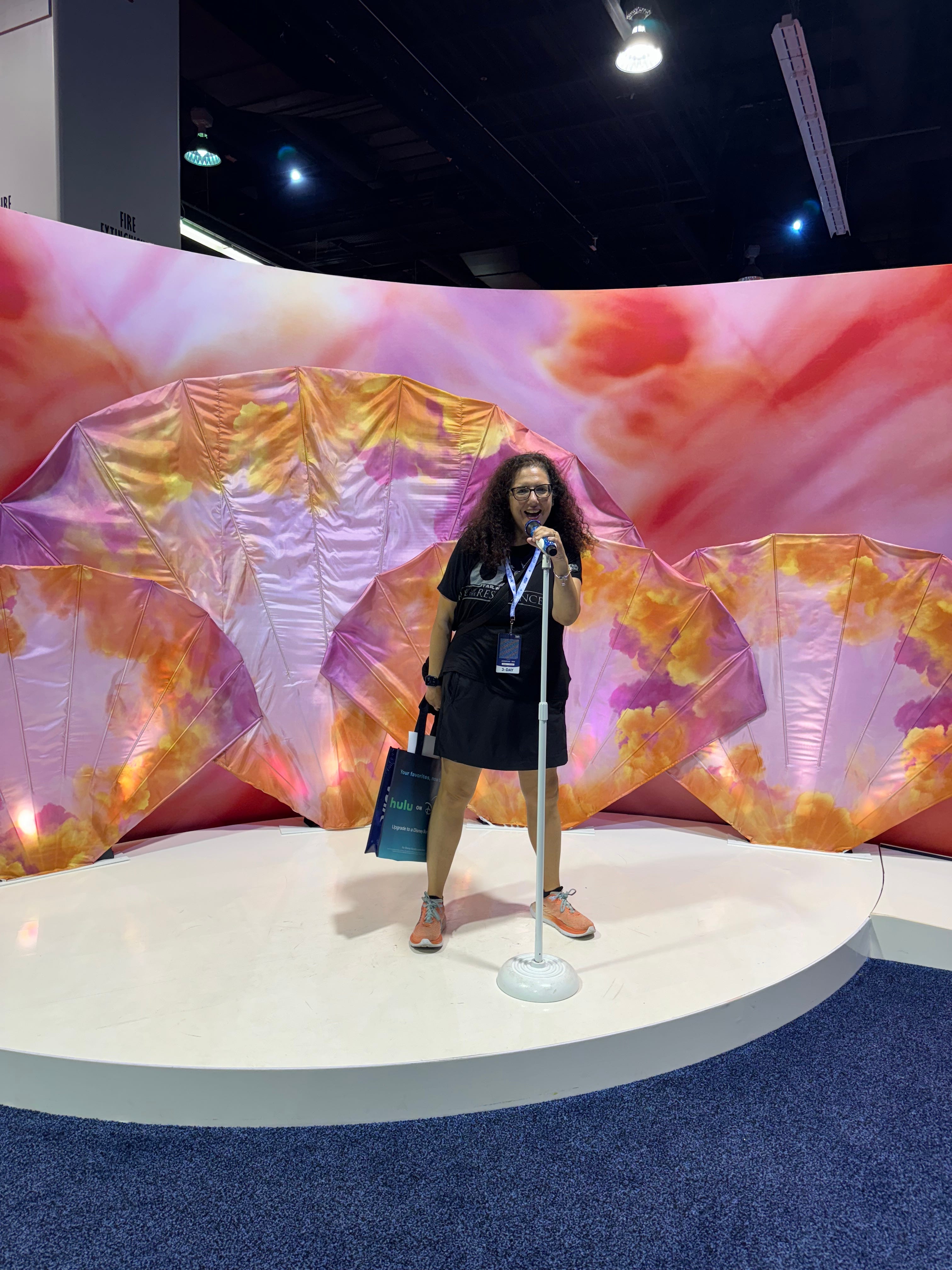
A ridiculous photo of me in my “D23 convention 2024 era” that illustrates the OPPOSITE of what I’m actually writing about today.
Think about it. If you grew up in the United States and attended public school, you probably had to sing in elementary school. That might be the last time you sang. You might have opted into chorus in junior high, or, like me, kept at it all the way through high school.
When is the last time you sang? Why?
Where do you still sing collectively in public?
Sporting events are still sites of singing. For baseball, we have “Take Me Out to the Ballgame,” and, if you are in Boston, “Sweet Caroline.” Team songs are a huge part of football culture abroad— and U.S. soccer fans have embraced it. They sang “Country Roads” after the final U.S. victory. Major sporting events, can be almost as costly as a Disney vacation—more costly per minute, depending on the stadium.
Concerts, of course, are for singing. The joy in the videos of the Eras tour seems to be, in part, about singing your heart out, ideally while wearing as many sparkles as humanly possible. (I’m still sad that I missed it). One of my own favorite concert memories is of the crowd singing along with Ed Sheeran in Philadelphia. He excels at the sing-a-long. Excels. But how often do you attend a stadium concert?
Then there are bars, true, but they still laud the individual performance, American Idol style. No shade to karaoke. I freaking LOVE karaoke. But that’s a situation where someone has the mic. Someone is in the spotlight.
Where else do we keep singing in person, in a big group?
**
“There’s a Great Big Beautiful Tomorrow” was written by Richard and Robert Sherman, Walt Disney Productions’ in-house songwriters from the early 1960s onward for many years. They wrote the song for the original Carousel of Progress, which debuted at the 1964 New York World’s Fair, and performed it on film with Walt Disney himself. It remained the attraction’s upbeat theme song for much of its life span (although, from 1975-1994, it was replaced by a different Sherman tune, “Now Is The Time.”).
The Sherman Brothers were fans of the English music hall style—another place of both performance and collective singing, which influenced Mary Poppins, their most famous work for Disney.
At the D23 Fan Convention in August 2024, Jamie Lee Curtis led the entire Honda Center in an impromptu sing-a-long of “There’s a Great Big Beautiful Tomorrow” when she accepted her Disney Legend award.
That’s about 12,000 people.
They all knew the words. Granted, they were Disney fans, so it was a self-selecting bunch.
I was there. At least in my section, everyone was dying, screaming, laughing, crying. Maybe it was spontaneous, or maybe it was planned. Either way, she had the crowd in the palm of her hand. We were all thrilled to sing along.
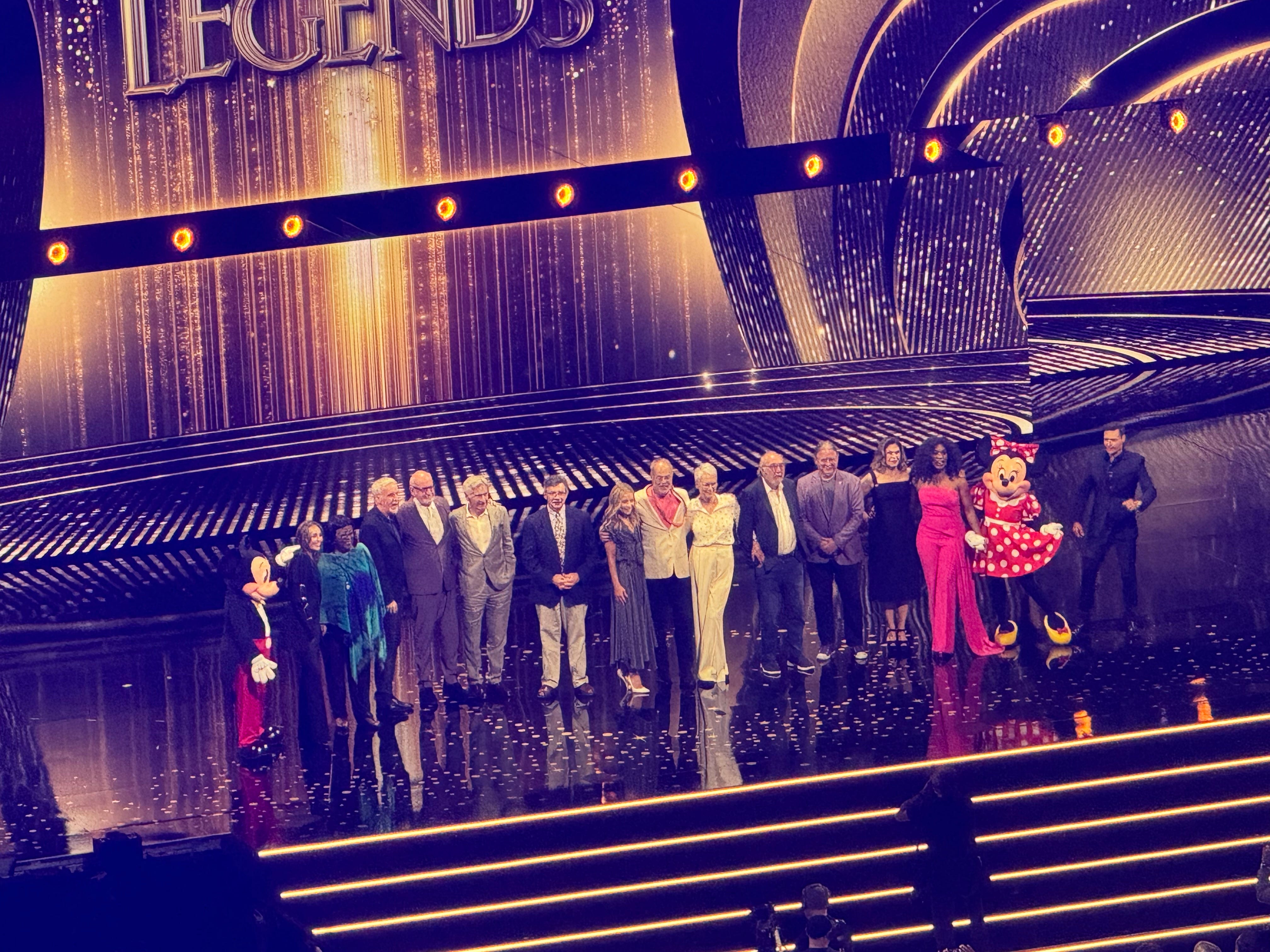
The Disney Legends Class of 2024. Yes I was in the same arena as Frank Oz and Harrison Ford. FRANK. OZ.
**
Singing solo is vulnerable. You take a deep breath and bare your soul, whether you are in a suburban living room or Carnegie Hall.
Like all performance, singing is risky. If you are singing alone, you never know what pitch might come out. When you press a piano key, if the piano is in tune, the right note will sound. (But playing ALL OF THOSE keys in the right sequence is crazy hard, which is why most of are not Jon Batiste). Instruments with strings are much trickier—frets, fingering, the works.
Like the Bryan Adams lyric about guitar, my daughter has played the bass until her fingers bled. She has a much better ear than I do.
But a few weeks ago I found myself explaining the existence of the humble pitch pipe. She has never seen one. I explained how the song leader would play one note and we would all find our place in the first chord. My brain remembers how I did that. I can’t do it anymore.
I was not a soloist kind of singer, but damn, did I love being in the chorus.
**
I’ve been thinking about Jonathan Larson and RENT a lot this year. RENT opened on Broadway thirty years ago, on April 29, 1996. Jonathan Larson, the show’s creator, died just before the show’s off-Broadway premier, of an aortic dissection likely caused by Marfan’s syndrome.
My own RentStory—which is so cliche and so extraordinary all at once—is for a longer essay someday. What matters today is that Rent was the collective soundtrack for my college years. It opened as I graduated from high school, and I saw the original Broadway cast a week before I left for school. At Brandeis University in the late 90s, you could walk up and down some hallways and hear that album drifting out multiple rooms. From one dorm room, “Light My Candle.” From the next, “Over the Moon.”
Part of RENT’s success is that it is damned singable.
Not every note, no. Some of it is very hard. I have made the grave error of taking Maureen’s part in “Take Me or Leave Me” during at-home karaoke (Thank goodness I wasn’t at a bar). Nope. Nope. Nope. Not for me. Both parts of that song are crazy hard, and killer. It is, as the kids say, fire, and always will be.
But “La Vie Boheme” is, at times, talk-singing. You can do it. You really can. And it’s so much fun to yell the lyrics.
RENT was the bonding agent for the theater nerds of my generation of Xennial college students. We all memorized it, and we could all sing it together—in the cars, in the dorms, wherever. To this day, not a single Christmas eve passes by without at least one person on my social media feeds posting on “December 24, 9 p.m, Eastern Standard Time.”
Singing together is how we sync our stories.
Do you have a #RENTStory? You can share it with Freddi Walker-Brown, amazing actor, director, and creator of the role of Joanne in original Broadway cast. I cannot wait for her new podcast.
**
On June 2, I spoke on a lovely roundtable about music in the Jewish Studies classroom at the biennial scholars’ conference of the American Jewish Historical Society. The panel paired musicologists and music professors with humanities professors like me—people who are not experts in music or professional musicians, but who use music in the classroom.
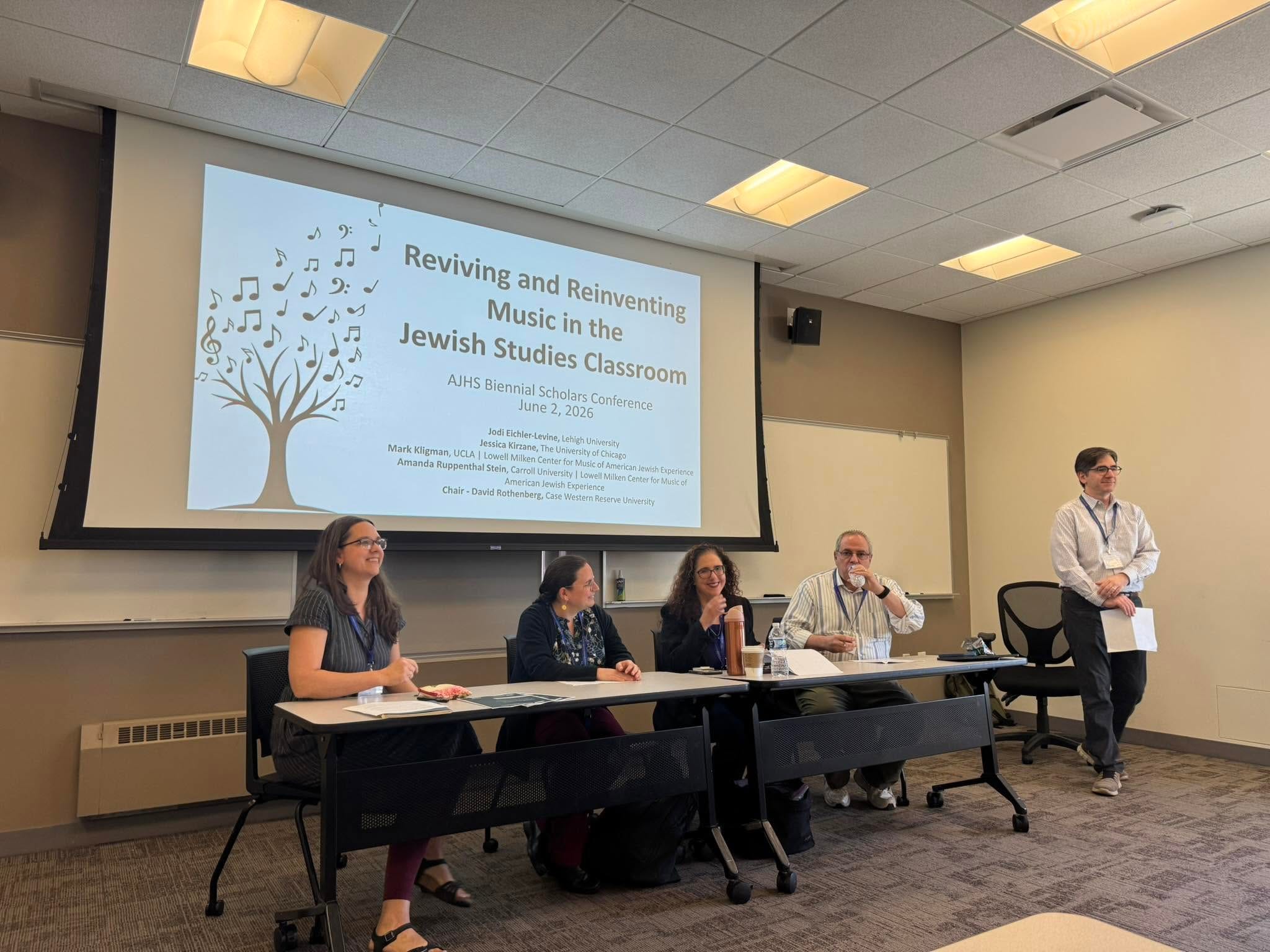
AJHS 2026
Professor Jessica Kirzane, one of my colleagues on the panel, uses singing in the Yiddish studies classroom. She led us in a little bit of a song, with the words on a Powerpoint slide. A lot of us managed to join in on the chorus. I’ve never sung with colleagues at a conference session before—at least, not that I remember. Certainly not while I was one of the panelist. Even for a few bars, it was special.
We prepared a lot for this panel, organized by the brilliant Dr. Amanda Ruppenthal Stein, and rounded out by the amazing musicologist Dr. Mark Kligman. On Zoom calls to prepare, when I learned that other professors actually sing in class both for and with their students, I was flabbergasted and envious.
It had never occurred to me that you could do that.
When I teach my Jews and the Broadway Musical class, I always do my impression of Kristen Wiig’s “Don’t Make Me Sing” character on Saturday Night Live. I never actually sing. I make the joke. Half the time, I have to show them a YouTube video for them to get it, because Kristen Wiig left the SNL cast in 2012, when my students were in elementary school.
I don’t actually sing with or to my students.
This is funny for several reasons. It’s funny, first, because in all other ways, music has always been a part of my classroom. I’ve always played music as part of my lessons. We analyze music and lyrics. In fact, the first time I heard Taylor Swift, it was in my “Intro to Women’s Studies” class at UW Oshkosh, circa 2009 or so. A group of students showed the “Love Story” video to analyze for an in-class assignment (their idea).
It’s also funny because I was in several of my high school’s choruses, went to summer theater camp, and even made it into regional chorus beginning my freshman year. I wasn’t good. But I sang a lot.
Singing more than a note or two in front of other people is not something I do anymore, except in ritual settings. For many years, pre-and-post-COVID height, I was chanting Torah and Haftarah regularly. Lately, for complex reasons, I don’t do that much, either. And it’s sort of a different thing. It is certainly different from collective singing.
Asking my students to sing truly never occurred to me. I ask them to cook. I offer them food. I go to their performances sometimes. If they bring their musical talents into their final projects, I am thrilled and I welcome it.
But building songs into the classroom seemed beyond me. Like it was an imposition that was somehow crueler than asking them to write or draw (yes, I ask them to draw). Like I had forgotten singing was a thing people just do sometimes.
I, the teacher of Disney who says we are all supposed to play, have apparently forgotten the number one rule of Disney.
Play is for everyone.
Perhaps I avoid singing because I loved it too much.
It is certainly why I majored in religion instead of music.
**
Community singing is slowly returning to movie palaces—where it thrived one hundred years ago. Yesterday’s New York Times had a great piece by style reporter Sarah Bahr on “Moana Mania” among young kids.
It’s a good take on something most parents experience: the rewatch. The re-listen. “How Far I’ll Go” over and over and over. The repeat viewing is in part about re-testing a child’s hypotheses; it’s in part about comfort; it’s in part about “the paradox of choice.” It’s also, yes, about the ear worms.
But we also want to sing together, in groups bigger than our family units or friend groups. Disney’s sing-a-long versions are just on Disney+, but there are other ways to sing in a theater. There were recent, popular sing-a-long screenings of Wicked and K-Pop Demon Hunters. Here in the Lehigh Valley, one of my local art house theaters has a summer sing-a-long series that includes Mary Poppins Hadestown will have extremely limited sing-a-long availability when it releases in cinemas later this month.
The people want to sing. We are lonely. We are shy, and we struggle to find things in common.
We might not all be ready for that karaoke microphone. But there is safety in numbers. In the darkness of our air conditioned movie halls, we can sing together, and no one can see our faces when the note breaks. As I learned in concert choir, sometimes someone can take a tiny, quick breath while someone else holds the note.
Maybe I’ll even get a tiny keyboard to tote into my fall classes.